Palais Royal
The Royal Palace
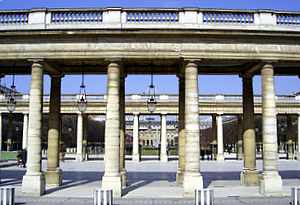
Palais Royal
Metro: Palais Royal-Musée du Louvre
Arrondissement: 1em
Go Here For Hotels In This Area
Map of the Area
Palais Royal was originally the home of Cardinal de Richelieu and was known as the Palais Cardinal. Construction of it began in 1629 by architect Jacques Lemercier.
There was, and is, a theatre at both ends of the galleries; the larger one has been the seat of the Comédie Française, the state theatre company, since Napoleon's reign.
This first theatre was built by Lemercier for Cardinal de Richelieu, in 1641. Under Louis XIV, the theater hosted plays by Molière, from 1660 to Molière's death in 1673. It then became used for opera under the direction of Jean-Baptiste Lully.
Richelieu bequeathed the palace to the French Crown. It later became the residence of the Queen-Mother Anne of Austria and the young Louis XIV.
During the minority of Louis XV, the regent of France, Philip II, Duke of Orléans, ruled from here.
From 1781-1784, his great-grandson, Louis Philip II, Duc d'Orléans, known as Philippe-Egalité, employed architect Victor Louis to rebuild the structures around the palace gardens and to enclose the garden with arcades. To cover the expense of this renovation he built boutiques among the arcades and rented them.
He then opened the Garden of the Palais Royal to the public. Interestingly, the Duc prohibited the police from entering these grounds. It was a place of freedom found nowhere else in the city.
Intellectuals, bankers, workers and artists would meet and discuss the political events of the day. People came here to get the latest news. It was the center of Parisian social life and had the most popular cafés. The restaurant, "Le Grand Vefour", is still there in the north-west corner.
On July 12, 1789, a young lawyer, Camille Desmoulins, announced to the crowd that Necker, the popular Director-General of Finances and Minister of State, had been dismissed.
He then raised two pistols and cried, "Citoyens, Aux armes!" ("Citizens, To arms!"). Two days later, the Bastille was taken and the Revolution was begun.
In the Revolution of 1848, a mob trashed and looted the Palais Royal.
Today, it is the home of the Conseil d'État, the State Council, the Constitutional Council and the Ministry of Culture.
Return to Top of Palais Royal Page
Private Tours
| Paris Introduction Tour | Paris Islands Tour | Paris Passages Tour |
| Trocodero-Eiffel-Invalides | Marais Tour | Montmartre Tour |
| Latin Quarter Tour | Paris Markets Tour | Paris Churches Tour |
Booking.com

New! Comments
Have your say about what you just read! Leave me a comment in the box below.